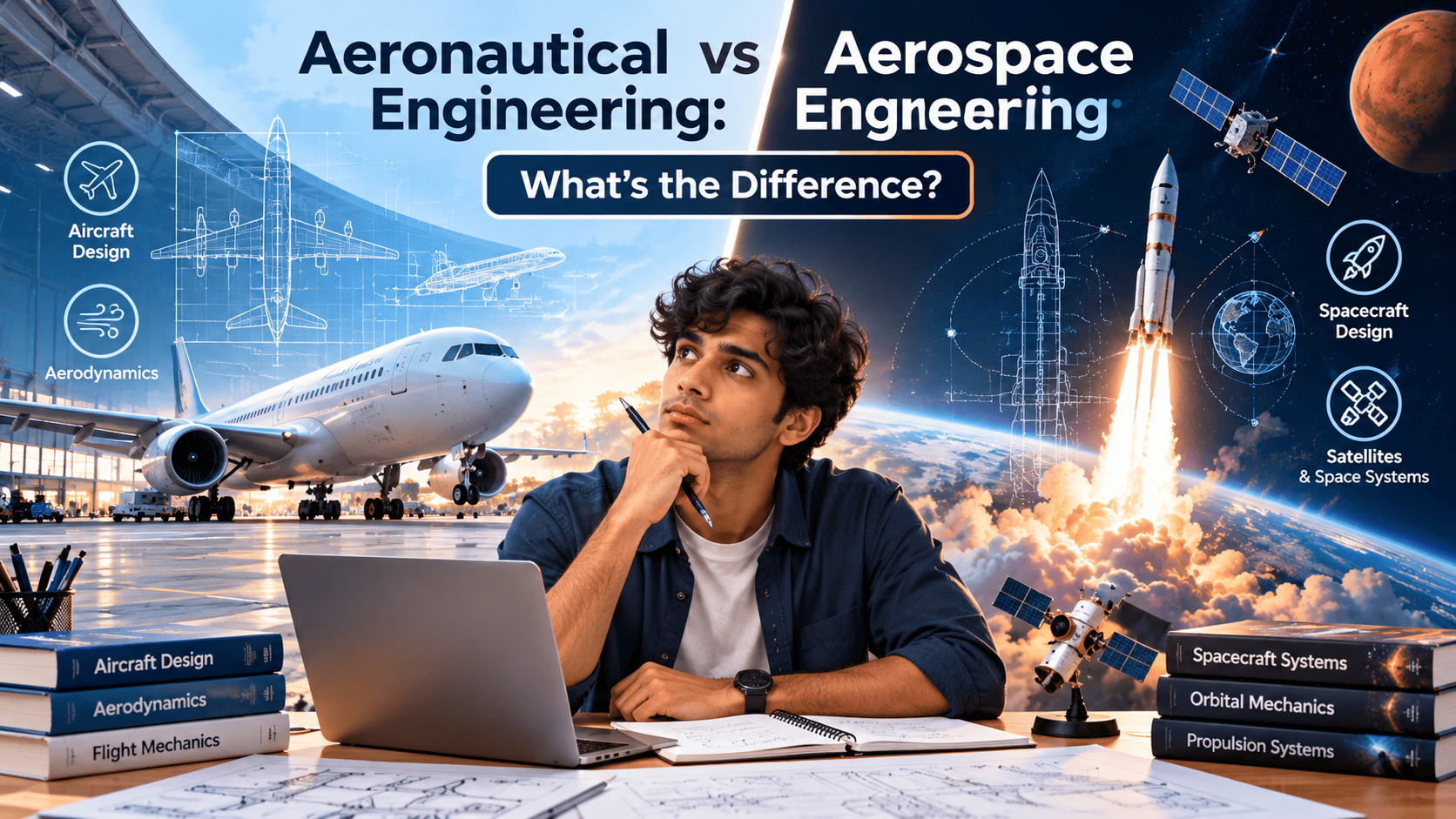
Aeronautical Engineering and Aerospace Engineering are closely related fields, but they differ in scope. Aeronautical Engineering focuses on aircraft operating within Earth’s atmosphere, while Aerospace Engineering encompasses both atmospheric flight and spaceflight, including satellites, rockets, and spacecraft. In simple terms, aeronautical engineering is a specialized branch within the broader field of aerospace engineering.
While both disciplines share a strong foundation in aerodynamics, propulsion, structures, and flight mechanics, they diverge in their areas of application and specialization. Understanding these differences can help students choose a programme that aligns with their interests and career aspirations.
What Is Aeronautical Engineering?
Table of Contents
ToggleAeronautical Engineering focuses on the design, development, analysis, testing, and maintenance of aircraft that operate within Earth’s atmosphere, such as aeroplanes, helicopters, and unmanned aerial vehicles (UAVs). Students gain knowledge of aerodynamics, aircraft structures, propulsion systems, avionics, flight mechanics, and airworthiness principles, preparing them for careers in aviation and related industries.
Did You Know?
MVJCE was the first institution under VTU to offer Aeronautical Engineering at both undergraduate and postgraduate levels. The department features facilities such as wind tunnels and flight simulation laboratories. Its B.E. Aeronautical Engineering programme has been NBA accredited since 2017-18 and is currently accredited through 2026-27.
What Is Aerospace Engineering?
Aerospace Engineering is a broader discipline that covers both atmospheric and space flight. It combines aeronautics, which deals with aircraft operating within Earth’s atmosphere, and astronautics, which focuses on spacecraft, satellites, launch vehicles, and space missions.
Students study many of the same core subjects found in aeronautical engineering while also exploring areas such as orbital mechanics, spacecraft design, satellite systems, rocket propulsion, space dynamics, and mission analysis. As a result, aerospace engineering prepares graduates for careers across both aviation and space-related industries.
Aeronautical vs Aerospace Engineering: Key Differences
Although there is significant overlap between the two programmes, their primary focus areas differ.
- Aeronautical Engineering emphasizes aircraft design, performance, propulsion, avionics, and atmospheric flight.
- Aerospace Engineering includes all of these areas while also covering spacecraft systems, orbital mechanics, rocket technology, and space exploration.
The choice ultimately depends on whether your interests are focused primarily on aviation or extend to both aviation and space technologies. Aeronautical Engineering offers greater specialization in aircraft systems, while Aerospace Engineering provides a broader perspective encompassing the entire spectrum of flight, from aircraft to spacecraft.
| Aspect | Aeronautical Engineering | Aerospace Engineering |
| Scope | Focused on aircraft and atmospheric flight | Broader; covers both aircraft and spacecraft |
| Core Domain | Aviation engineering | Aviation engineering + space technology |
| Key Focus Areas | Aerodynamics, structures, propulsion, avionics | Aerodynamics, structures, propulsion, avionics, plus orbital mechanics, spacecraft design |
| Operating Environment | Earth’s atmosphere | Atmosphere and outer space |
| Industry Alignment | Airlines, aircraft manufacturers, defence aviation | Aviation, space agencies, satellite, and rocket companies |
The distinction between Aeronautical and Aerospace Engineering can be summed up as specialization versus scope. If you’re fascinated by aircraft design, flight performance, and propulsion systems, Aeronautical Engineering offers a focused pathway into the world of aviation. If your interests extend beyond aircraft to include satellites, launch vehicles, and space exploration, Aerospace Engineering provides a broader perspective and a wider range of applications.
What Subjects Do Students Study?
Both programmes begin with a strong foundation in mathematics, physics, and core engineering sciences. Students in both fields study subjects such as aerodynamics, fluid mechanics, propulsion systems, flight mechanics, structures, and materials science.
As the programmes progress, their focus begins to diverge. Aeronautical Engineering places greater emphasis on aircraft design, avionics, flight performance, and airworthiness. Aerospace Engineering builds on these fundamentals while introducing specialized topics such as orbital mechanics, spacecraft design, rocket propulsion, satellite technology, and space mission dynamics.
What Career Areas Can Each Programme Lead To?
Graduates of Aeronautical Engineering may pursue careers in aircraft design, manufacturing, testing, structural analysis, propulsion systems, avionics, quality assurance, and UAV development. Opportunities also exist in aircraft maintenance and airworthiness-related fields, subject to the relevant regulatory qualifications and licensing requirements.
Aerospace Engineering graduates can explore all of these areas while also pursuing opportunities in spacecraft systems, satellite technology, launch vehicles, space research, and mission planning. As government and private-sector investments in the space industry continue to grow, career opportunities are expanding across both aviation and space-focused sectors.
Who Should Choose Aeronautical Engineering?
Aeronautical Engineering is ideal for students whose interests are primarily focused on aircraft and aviation. If you are fascinated by aircraft design, flight operations, aviation technology, airline systems, or defence aviation, this programme offers the depth and specialization needed to build a career in those areas.
Who Should Choose Aerospace Engineering?
Aerospace Engineering is well suited for students who are equally interested in aviation and space technology. If rockets, satellites, spacecraft, and space exploration capture your imagination alongside aircraft, Aerospace Engineering provides a broader academic and career pathway.
Aeronautical or Aerospace Engineering: How Should You Choose?
The choice ultimately depends on your interests and career aspirations. Ask yourself:
- Are you primarily interested in aircraft, or do you also want to explore space technologies?
- Do you see yourself working in aviation, spacecraft development, satellite systems, or launch vehicles?
- Would you prefer a focused specialization or a broader multidisciplinary field?
Neither programme is inherently better than the other. Both offer strong engineering foundations, excellent career opportunities, and the flexibility to pursue advanced studies and emerging technologies.
Aeronautical and Aerospace Engineering at MVJCE
MVJ College of Engineering (MVJCE) offers dedicated B.E. programmes in both Aeronautical Engineering and Aerospace Engineering. The programmes combine strong theoretical foundations with practical learning through specialized laboratories, including wind tunnel, flight simulation, propulsion, structures, and materials testing facilities.
Students benefit from project-based learning, design challenges, UAV development activities, guest lectures, industrial visits, technical clubs, and participation in competitions such as the National Aerospace Conceptual Design Competition (NACDeC). These experiences help bridge classroom learning with real-world industry applications and prepare students for careers in aviation, aerospace, defence, and emerging space technologies.
Conclusion
Aeronautical and Aerospace Engineering share a common foundation in aerodynamics, propulsion, structures, and flight mechanics but differ in their scope of application. Aeronautical Engineering focuses on aircraft and atmospheric flight, while Aerospace Engineering extends into spacecraft, satellites, launch vehicles, and space exploration. The right choice depends on whether your passion lies exclusively in aviation or spans both aviation and the rapidly expanding frontier of space technology.
FAQs
1. What is the main difference between Aeronautical and Aerospace Engineering?
Aeronautical Engineering focuses on aircraft and flight within Earth’s atmosphere, while Aerospace Engineering covers both aircraft and spacecraft, including satellites, rockets, and space systems.
2. Is Aerospace Engineering broader than Aeronautical Engineering?
Yes. Aerospace Engineering encompasses both aeronautics (aircraft and atmospheric flight) and astronautics (spacecraft and space systems), giving it a wider scope than Aeronautical Engineering.
3. Can an Aeronautical Engineer work in the aerospace industry?
Yes. Aeronautical engineers can pursue careers in aircraft design, manufacturing, testing, maintenance, avionics, and aviation operations. However, roles involving spacecraft, satellites, and launch vehicles may require additional knowledge of space-related subjects.
4. Which engineering programme is better for aircraft design?
Both programmes cover aircraft design fundamentals. However, Aeronautical Engineering offers greater specialization in aircraft systems, aerodynamics, flight performance, and aviation technologies, making it particularly suitable for students focused on aircraft design.
5. Which programme should I choose if I’m interested in spacecraft?
Aerospace Engineering is generally the better choice for students interested in spacecraft, satellites, orbital mechanics, and rocket propulsion. It provides broader exposure to both aviation and space technologies.
6. Do Aeronautical and Aerospace Engineering have common subjects?
Yes. Both programmes share a strong foundation in subjects such as aerodynamics, fluid mechanics, propulsion systems, flight mechanics, structures, and materials science. The specialization typically occurs in the later stages of the programme.
