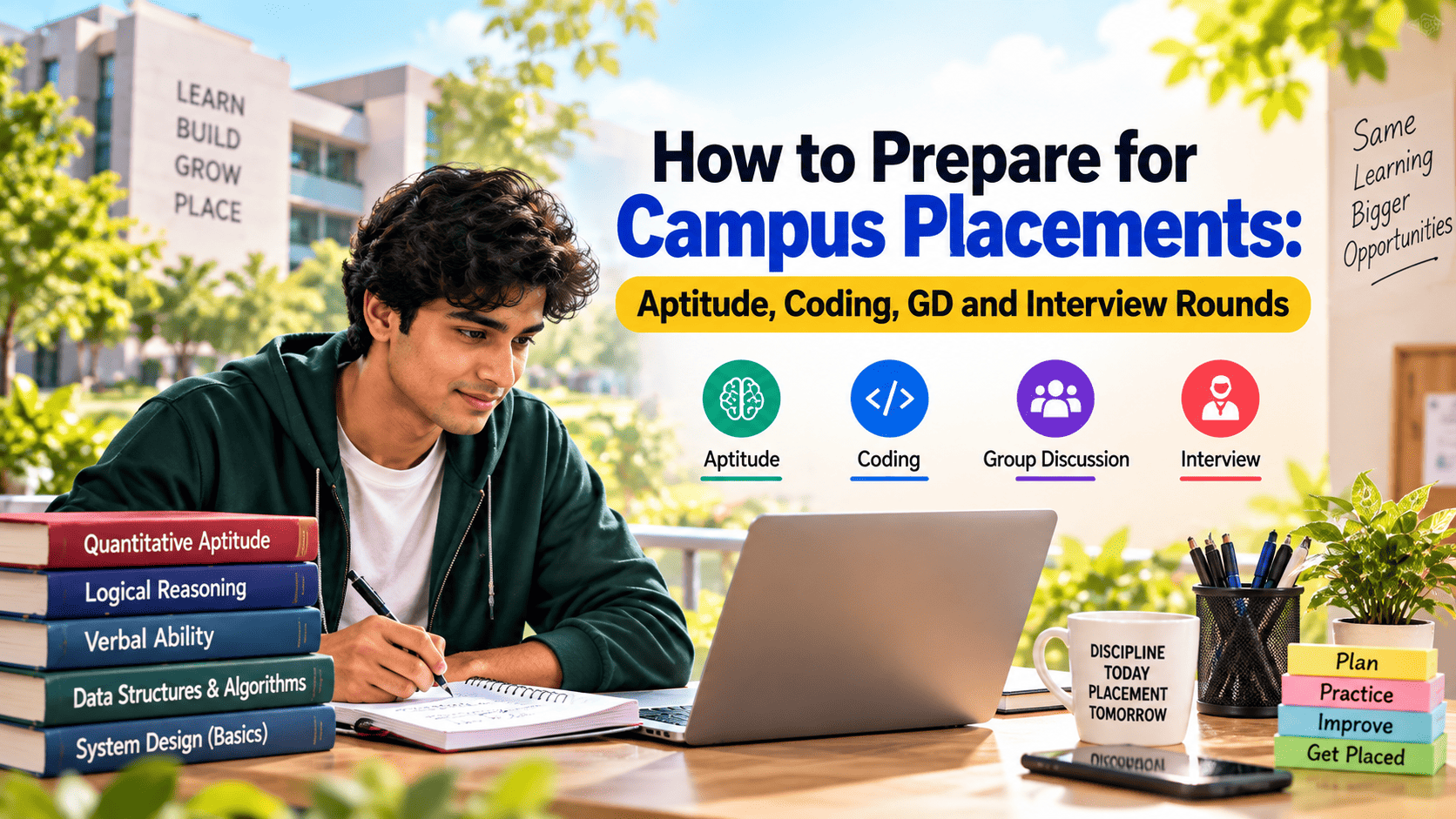
Preparing for campus placements requires a structured approach that covers aptitude tests, coding assessments, group discussions, technical interviews, and HR rounds. Students should start preparing well in advance by strengthening problem-solving skills, practising coding regularly, revising core subjects, improving communication skills, and taking mock interviews. A focused six-month preparation plan can help engineering students build confidence and handle each stage of the placement process effectively.
This guide explains how to prepare for campus placements, what recruiters evaluate in each round, and the key steps students can follow to improve their placement readiness.
What the Campus Recruitment Process Actually Looks Like
Table of Contents
ToggleEffective preparation begins with a clear map of the campus recruitment process, which most companies structure as a funnel that narrows the applicant pool at each stage.
A typical recruitment drive includes these steps:
- Pre-placement talk: The company introduces its work, roles, and expectations.
- Aptitude test: A timed online round on quantitative, logical, and verbal skills.
- Coding or technical test: Programming problems or role-specific questions.
- Group discussion: A shortlisting round used mainly by large recruiters.
- Technical interview: One or more rounds on subject knowledge and projects.
- HR interview: The closing round on fit, communication, and intent.
Few companies conduct all six stages of the recruitment process. In general, higher-paying roles may involve additional rounds and more rigorous evaluation. Therefore, students should review the recruitment process of their target companies rather than assume a standard format applies to all recruiters.
The India Skills Report 2026 recorded overall student employability at 56.35%, up from 54.81% of the previous year. Engineering fares better than the national average, with computer science graduates at 80% and IT engineers at 78%, but those figures reflect candidates who prepared, not candidates who simply graduated.
Round 1: Cracking the Aptitude Test
The aptitude test is often the first major screening stage, and many capable students are eliminated due to insufficient timed practice. Structured aptitude preparation plays a critical role in clearing this round.
Three key areas are typically assessed:
- Quantitative Aptitude: Percentages, ratios, time and work, probability, and related topics.
- Logical Reasoning: Number series, puzzles, coding-decoding, and seating arrangements.
- Verbal Ability: Grammar, comprehension, and vocabulary.
Since these tests are highly time-sensitive, accuracy alone is not enough. Effective preparation should begin with topic-wise practice and gradually progress to full-length mock tests under timed conditions. Identify areas that require extra time and focus additional practice on improving both speed and accuracy.
Round 2: The Coding and Technical Test
This round determines most engineering shortlists and is a critical part of campus placement preparation for engineering students. Recruiters evaluate whether candidates can write efficient, functional, and well-structured code within a limited time.
A strong foundation in data structures and algorithms is essential, including arrays, strings, linked lists, stacks, queues, trees, sorting, and searching techniques. Students should choose one programming language, such as C++, Java, or Python, and build proficiency in it rather than dividing their attention across multiple languages.
Success in coding assessments is achieved through consistent daily practice rather than occasional intensive preparation. Recruiters also value candidates who can clearly explain their approach and thought process while solving problems. This skill becomes especially valuable during technical interviews.
Round 3: Group Discussion
Not every recruiter conducts a group discussion round; however, many large organizations use it as a shortlisting tool.
Recruiters assess communication skills, clarity of thought, confidence, teamwork, and the ability to contribute meaningfully to a discussion. Staying informed about current affairs, business trends, and technological developments can help students participate effectively.
Practising mock group discussions can develop the ability to enter discussions at the right time and express ideas clearly. In a GD, quality of contribution is more important than quantity.
Round 4: The Technical Interview
The technical interview is often the most critical stage of the recruitment process and requires thorough preparation.
Questions typically focus on core subjects, academic projects, internships, and technical skills mentioned in the resume. Candidates applying for software roles should revise operating systems, database management systems, computer networks, object-oriented programming, and data structures.
Candidates should also be prepared to explain their project work in detail. When faced with an unfamiliar problem, it is important to communicate the thought process and approach rather than remain silent. Interviewers often value logical reasoning and problem-solving ability in addition to the final answer.
Round 5: The HR Interview
The HR interview primarily evaluates communication skills, attitude, career goals, and cultural fit within the organization.
Students should prepare thoughtful responses to commonly asked questions regarding strengths, weaknesses, career aspirations, and reasons for choosing the company. Researching the organization beforehand helps demonstrate genuine interest and preparation.
Speaking confidently, maintaining professionalism, and communicating clearly can leave a positive impression during this stage.
A Six-Month Preparation Timeline
Intent without a schedule goes nowhere. The table maps out one workable way to plan how to prepare for campus placement over six months.
| Period | Focus Area | Key Actions |
| Months 1 to 2 | Foundations | Strengthen aptitude fundamentals.Revise data structures and programming basics.Solve coding problems regularly. |
| Months 3 to 4 | Building depth | Progress to medium-level coding challenges.Take weekly aptitude mock tests.Revise core academic subjects. |
| Month 5 | Application | Participate in mock interviews and group discussions.Take full-length placement tests.Refine and update your resume. |
| Month 6 | Final Preparation | Revise projects and technical concepts.Practise HR interview questions.Participate in company-specific mock recruitment drives. |
Following a structured preparation plan can help students approach every stage of the campus recruitment process with confidence.
Start Your Placement Journey at MVJCE
Students who succeed in campus placements are those who begin preparation early and approach each stage with consistency and purpose.
Institutional support plays an important role in transforming preparation into successful outcomes. MVJCE provides 250 hours of structured placement and skill development training across all four years of study. The training progresses from communication skills and aptitude development in the early years to domain-specific technical preparation, mock interviews, and company-specific training during the final years.
Explore the programmes and placement support available at MVJCE and build your career on a strong foundation for professional success.
FAQs
1. When should I start preparing for campus placements?
Ideally, students should begin preparing at least six months before the placement season, typically during the second half of the third year. This provides adequate time to strengthen aptitude skills, practise coding, revise core subjects, and prepare for interviews.
2. Do core branch students need to learn coding?
Yes. Many recruiters, including those hiring for core engineering roles, assess basic programming and problem-solving skills. A working knowledge of programming can significantly expand career opportunities.
3. How important is CGPA in campus placements?
CGPA often serves as an initial eligibility criterion during campus recruitment. Many companies specify a minimum CGPA requirement, commonly ranging from 6.0 to 7.0 or higher. Maintaining a good academic record keeps more placement opportunities open.
4. How many companies visit an engineering college for placements?
The number varies across institutions. Established engineering colleges typically attract recruiters from IT services, product companies, startups, consulting firms, and core engineering sectors. Students should refer to their institution’s placement records for the latest statistics.
