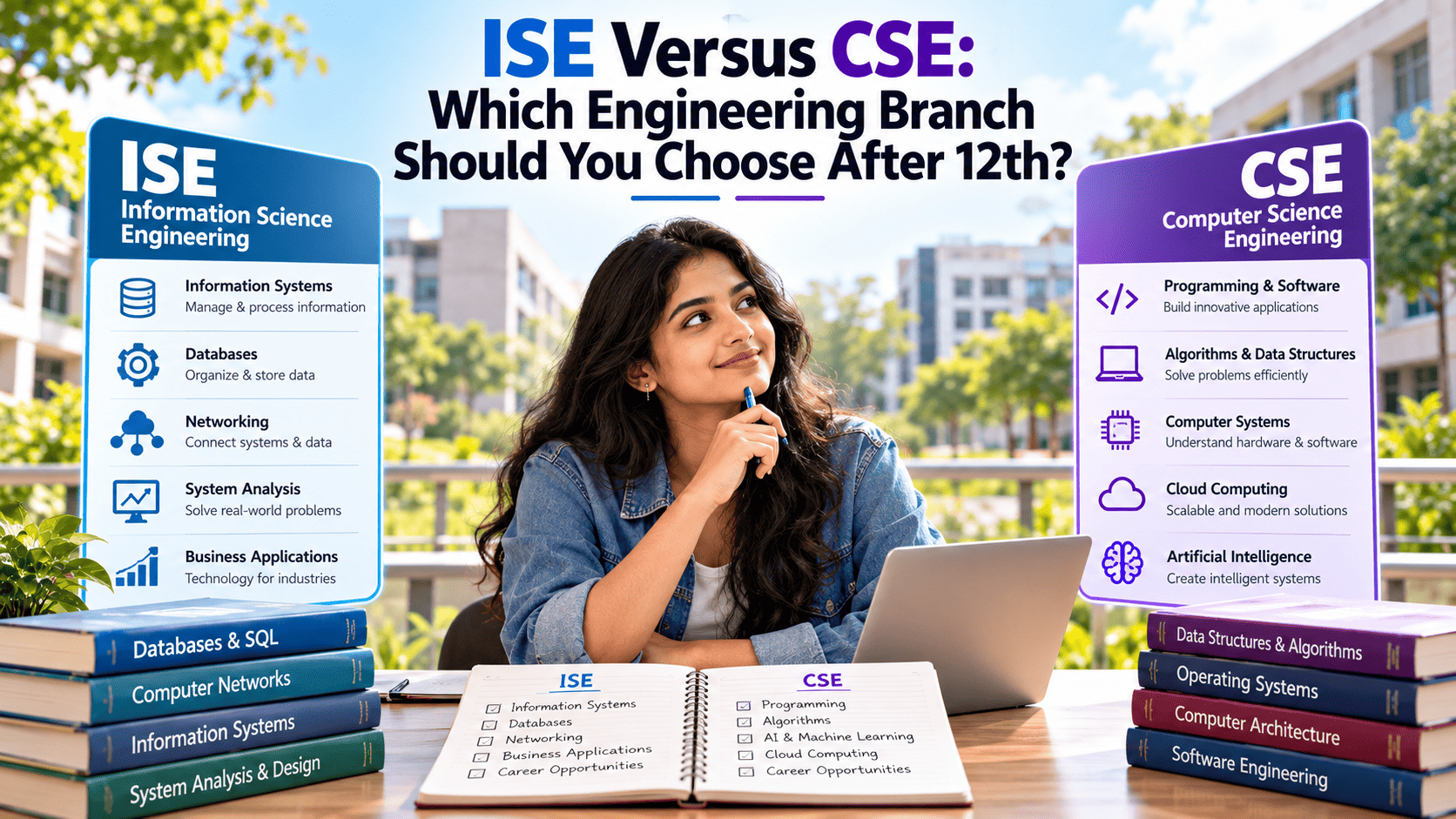
Choosing between top tech options like ISE vs CSE after school can feel confusing. Most of the time, students do not fully understand the difference. Both options lead to strong tech careers, but their academic focus is different.
Computer Science Engineering focuses on programming, software systems, and core computing. On the other hand, Information Science and Engineering deals with information systems, data, cloud platforms, and practical software applications.
So, do not just ask, “Which is better, ISE or CSE?” when planning for long-term growth. Continue reading for a clear comparison of ISE and CSE to understand which programme best aligns with your interests and career goals.
What Is CSE?
Table of Contents
ToggleCSE covers how software, computers, and digital architectures operate. It builds strong foundations in abstract thinking, system design, and algorithmic problem-solving. Key subject areas include:
- Programming and Software Engineering
- Data Structures & Algorithms
- Computational Thinking
- Web Technologies
- Machine Learning & Artificial Intelligence
- Database Management Systems
CSE may suit students who enjoy coding and want to understand how software and computing systems are designed, building toward a career in technology.
What Is ISE?
Information Science and Engineering focuses on software development, data, information management, cloud computing, networking, and digital systems. MVJCE’s ISE programme covers practical applications and emerging technologies. Key focus areas include:
- Enterprise Application Development
- Data Analytics & Big Data Management
- Cloud Infrastructure & DevOps
- Full-Stack Development
- Network Architecture & Information Security
- Mobile and Web Application Design
Best suited for: Students who enjoy applying technology to solve practical business challenges, managing data systems, and leveraging cloud platforms.
Key Differences Between ISE and CSE
The ISE vs CSE syllabus difference is not a complete divide. They have some similarities in covering programming, software, databases, data, and modern technologies. However, the two branches differ in their academic emphasis.
| Feature | Computer Science & Engineering | Information Science & Engineering |
| Curriculum | Core computing, programming, algorithms, software, and computer systems | Computing, software, data, information systems, cloud platforms, and related applications |
| Focus Area | Design and development of software and computing systems | Management, processing, and practical use of digital information |
| Core Subjects | Programming, data structures, algorithms, databases, operating systems, and machine learning | Programming, data structures, databases, cloud computing, data analytics, networking, and cybersecurity |
| Practical Exposure | Laboratories, projects, internships, and industry interactions | Laboratories, projects, internships, data tools, and application development |
| Popular Roles | Software Engineer, Systems Engineer, AI/ML Engineer, Data Analyst, and Cloud Engineer | Software Developer, Data Engineer, Full Stack Developer, Security Analyst, and Cloud Specialist |
Career Opportunities After CSE
CSE graduates can apply for roles in software, data, cloud computing, networks, cybersecurity, research, and technical support.
MVJCE lists several popular job roles for CSE graduates:
- Software Development Engineer
- AI/Machine Learning Engineer
- Cloud Infrastructure Architect
- Cybersecurity Engineer
- Systems Architect/Engineer
- Database Administrator
The CSE programme in MVJCE supports project-based learning. It also includes internships, workshops, industry interaction, and laboratory work. These activities help students develop technical knowledge and workplace skills.
Career Opportunities After ISE
ISE graduates can explore roles across software, data, cloud computing, networking, and cybersecurity, entering several technology sectors with their skills.
MVJCE lists the following job roles for ISE graduates:
- Full-Stack/Web/Mobile Developer
- Data Scientist/Engineer
- DevOps Engineer
- IT Consultant
- Cybersecurity Specialist
- UI/UX Architect
ISE may suit students interested in information systems, data platforms, software services, and applied computing.
CSE vs ISE Placements: What Should Students Compare?
A CSE vs ISE placement review is more than just checking the highest package. It is about the personal interest, job description, required skills, selection rounds, and work location.
MVJCE provides college-level placement statistics. As of 27 July 2026, MVJCE reports 72% placement for the ongoing 2025–26 season, with a ₹19 LPA highest package and a ₹7 LPA average package. For the completed 2024–25 season, MVJCE reported 84% placement, with a ₹23 LPA highest package and a ₹7.5 LPA average package. These are college-level figures and should not be treated as separate CSE or ISE results. It is better to consider these factors before comparing the two branches:
- Recruiter eligibility rules
- Coding requirements
- Aptitude performance
- Internship experience
- Academic results
- Relevant certifications
- Project quality
- Interview performance
- Communication skills
Software recruiters may consider students from both branches. However, each company can set its own eligibility conditions.
Which Is Better ISE or CSE?
The choice depends on the subjects a student enjoys. Neither branch is inherently better than the other. Evaluating the ISE vs CSE syllabus difference shows whether you prefer core coding or enterprise applications.
Consider the following factors when choosing your stream. Go for one that will keep you motivated for four years.
- Choose CSE if you prefer core algorithms, low-level system design, software engineering theory, and advanced computing fields like AI.
- Choose ISE if you prefer data-driven platforms, applied software development, cloud infrastructure, and enterprise system management.
- Compare the current curriculum before option entry.
- Consider roles available during placements.
- Verify Entrance Requirements: Check cutoffs and counselling procedures for both branches under KCET or management entry routes before finalizing choices.
Do not just search for the best engineering branch after 12th Bangalore for a secure career path. Give equal importance to your interests and abilities. However, both branches require coding practice, clear fundamentals, and regular learning.
Think about which day-to-day work you would enjoy the most before asking which is better ISE or CSE.
Cutoffs and Admission Checks
The MVJCE CSE cutoff should be confirmed based on the latest official counselling information. Closing rank may differ depending on the categories, counselling rounds, modes of admission, and available seats. At MVJCE, admission to undergraduate programmes follows KCET and management-quota procedures The management route accepts KCET, COMEDK, or JEE Main scores, along with a test conducted by the college.
Confirm the MVJCE ISE cutoff for the same year and counselling round in the same way.
Why MVJCE Is a Good Fit for Both Branches
MVJ College of Engineering in Whitefield offers a comprehensive list of programmes for students seeking the best engineering branch after 12th in Bangalore. Both departments provide laboratory facilities that support practical learning and curriculum-based project work.
Admission ranks vary each year, so it’s worth confirming the latest CSE and ISE cutoffs before finalising a choice.
Either branch can be a strong choice at MVJCE, as both departments provide laboratories and academic support. However, it is vital to review the curriculum, visit the campus, and speak with the admissions team before choosing a branch.
Frequently Asked Questions
1. Is ISE easier than CSE?
ISE is not necessarily easier than CSE. Both branches include programming, mathematics, laboratory work, projects, and problem-solving. The level of difficulty depends on the student’s interests and preparation.
2. Which has better placements, ISE or CSE?
It completely depends upon the eligibility criteria of the recruiters and performance of the students.
CSE is often more popular among applicants, but this does not mean that the options for ISE would be less in software, data sciences, cloud computing, cyber security, or application development.
3. Can I switch from ISE to CSE or vice versa after joining?
Branch-change provisions may vary depending on the applicable regulations and batch. Students should contact the Admissions Office of the College.
4. Does higher-package recruitment favour CSE over ISE?
Access to higher-paying roles does not depend on the branch name alone.
Recruiters may assess coding ability, technical knowledge, projects, aptitude, communication, and interview performance.
5. Which branch is better for higher studies abroad?
Both branches can support applications for higher studies abroad. Admission will depend on the university’s subject, credit, academic, and language requirements.
CSE can support applications for programmes in computer science, artificial intelligence, software engineering, and related fields. ISE can support applications in information systems, data science, cloud computing, cybersecurity, and software engineering.
Admission requirements for higher studies vary from one university to another and depend on the specific programme of study.
