Artificial Intelligence is evolving rapidly. Today, AI can do far more than answer questions or generate content. Across industries, it is being used to analyse information, support decision-making, automate complex workflows, and perform multi-step tasks. As AI systems become increasingly capable of planning, reasoning, and acting with minimal human intervention, new opportunities are emerging in the fields of Agentic AI and Autonomous Systems.
For engineering students exploring future-focused career paths, this transformation represents a significant shift. The next generation of intelligent systems will not only process information but also make decisions and execute actions to achieve defined objectives. As a result, careers related to Agentic AI and Autonomous Systems are expected to play an increasingly important role in the technology landscape.
What Is Agentic AI?
Table of Contents
ToggleAgentic AI refers to AI systems that can work towards a specific goal with limited human supervision. Unlike traditional AI systems that respond to individual prompts or tasks, agentic systems can plan a sequence of actions, use tools, access information, evaluate outcomes, and adjust their approach while pursuing an objective.
These intelligent AI agents combine capabilities such as reasoning, planning, memory, and decision-making to complete complex workflows more autonomously. Examples include AI assistants that manage projects, coordinate tasks across applications, analyse data, and generate recommendations based on changing conditions.
Students interested in careers in Agentic AI should first build strong foundations in programming, algorithms, data structures, databases, and machine learning. These fundamentals provide the knowledge required to understand and develop advanced AI systems capable of autonomous decision-making and task execution.
What Are Autonomous Systems?
Autonomous systems perform tasks with limited human intervention. Using data, software, and often sensors, they assess conditions, make decisions, and take appropriate actions. Career opportunities in this field span intelligent software, robotics, connected devices, and industrial automation.
How Are Agentic AI and Autonomous Systems Connected?
Agentic AI and autonomous systems both operate with a degree of independence from human control. Agentic AI focuses on software that can reason, plan, and act toward goals, while autonomous systems apply similar intelligence to software or physical machines. In multi-agent systems, multiple AI agents collaborate to achieve shared objectives, combining planning, coordination, and decision-making capabilities.
What Technologies Should Engineering Students Learn?
Students interested in Agentic AI and Autonomous Systems should build a strong foundation in machine learning, programming, algorithms, and data analytics. Understanding generative AI, reinforcement learning, multi-agent systems, and robotics can provide deeper insights into how intelligent systems learn, plan, and make decisions. Knowledge of cloud computing, APIs, model deployment, and system testing is also valuable for developing reliable AI solutions.
What Career Opportunities Are Connected to Agentic AI?
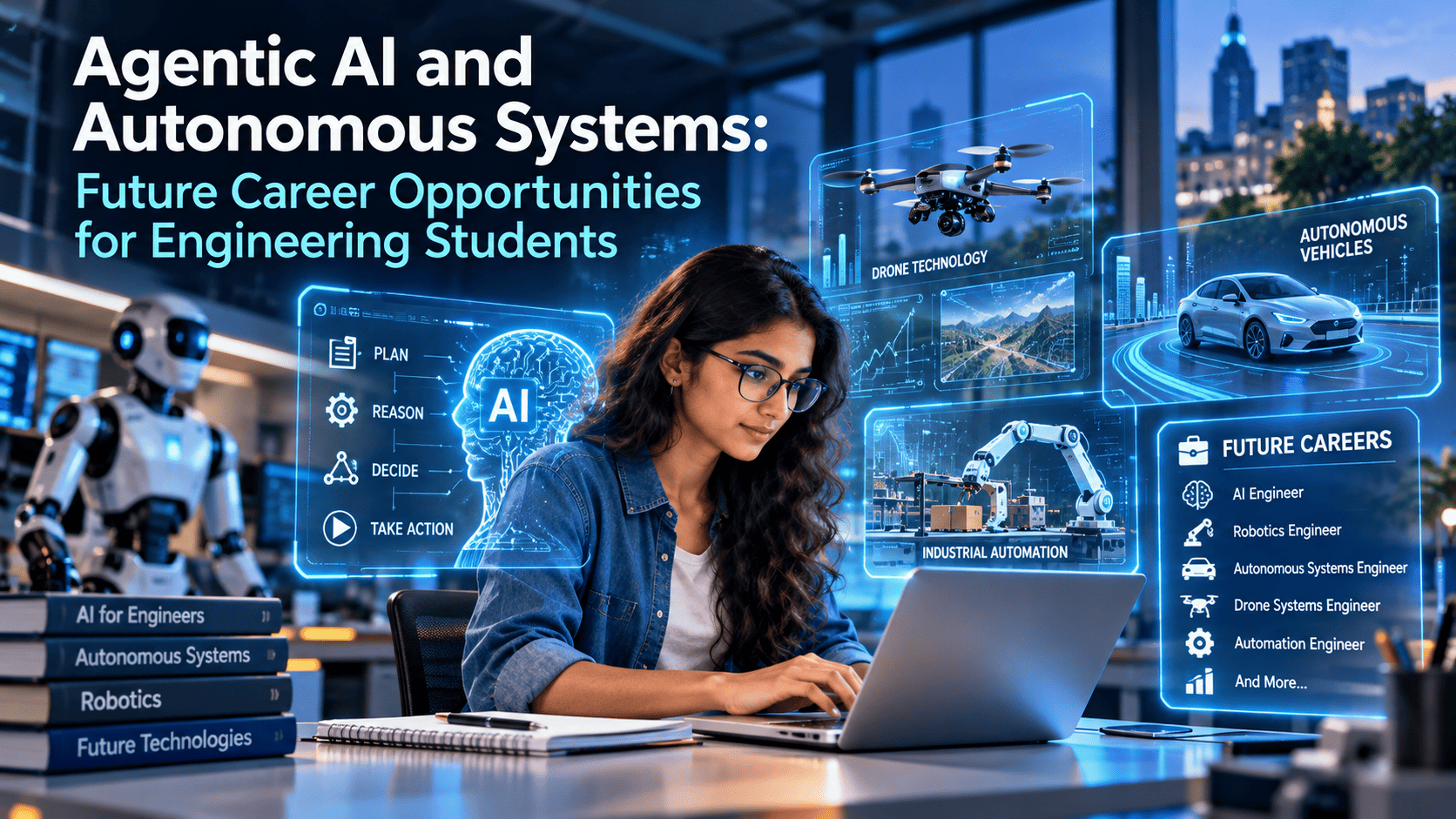
As Agentic AI continues to evolve, new opportunities are emerging across AI, software engineering, automation, and data science. Potential career paths include:
- AI/ML Engineer – Develops intelligent models and AI-powered applications.
- AI Agent Developer – Designs agents that plan, reason, and execute tasks autonomously.
- Data Scientist – Builds predictive models and extracts insights from data.
- Robotics Engineer – Develops intelligent systems that interact with physical environments.
- MLOps Engineer – Deploys, monitors, and optimizes AI models in production.
- AI Evaluation Engineer – Tests AI systems for performance, reliability, and safety.
These roles represent growing opportunities for engineering graduates with strong technical and problem-solving skills.
Which Industries Could Use Agentic and Autonomous Systems?
Agentic and autonomous technologies have the potential to transform industries that rely on data, automation, and real-time decision-making. From manufacturing and healthcare to transportation, finance, logistics, and agriculture, these technologies can improve efficiency, support faster decision-making, and enable more intelligent operations.
| Industry | Potential Applications |
| Manufacturing | Production monitoring, predictive maintenance and quality control |
| Healthcare | Clinical data analysis, patient monitoring and administrative workflows |
| Transportation | Route planning, traffic management and autonomous mobility |
| Finance | Fraud detection, risk assessment and automated financial analysis |
| Logistics | Inventory monitoring, warehouse automation and delivery planning |
| Agriculture | Crop monitoring, precision farming and automated equipment |
Careers in autonomous systems can span software development, robotics, sensor technologies, and intelligent machines. To work effectively in this field, students should also develop an understanding of system safety, testing, reliability, and human oversight, as these are critical to the responsible deployment of real-world autonomous solutions.
How Can Engineering Students Prepare for This Field?
Engineering students should focus on building strong fundamentals before exploring advanced Agentic AI and autonomous systems. Since these technologies combine multiple disciplines, a practical, hands-on approach to learning is essential.
Students can prepare by:
- Learning Python and other relevant programming languages.
- Understanding algorithms, data structures, and databases.
- Building a foundation in machine learning and deep learning.
- Studying cloud computing, APIs, and model deployment.
- Developing simple AI agents for specific tasks.
- Exploring robotics, reinforcement learning, and multi-agent systems.
- Understanding AI testing, reliability, safety, and governance.
Beyond coursework, projects, internships, hackathons, workshops, and research activities provide valuable opportunities to apply these concepts and demonstrate practical skills.
Exploring Agentic AI at MVJCE
MVJCE‘s B.E. Artificial Intelligence and Machine Learning programme introduces students to technologies that underpin modern intelligent systems. The curriculum includes areas such as machine learning, deep learning, generative AI, large language models, computer vision, reinforcement learning, MLOps, cloud computing, and data analytics.
Students gain practical exposure through laboratory sessions, industry-focused projects, workshops, technical events, and project-based learning activities. These experiences help bridge the gap between theoretical understanding and real-world implementation.
The Department of Artificial Intelligence and Machine Learning also conducts technical programmes and skill-development initiatives on emerging AI technologies. Such activities provide students with opportunities to explore contemporary developments and understand how advanced AI concepts can be applied to solve real-world challenges.
Conclusion
Agentic AI and autonomous systems are shaping the future of intelligent technology across industries. As organizations increasingly adopt systems capable of reasoning, planning, and acting with minimal human intervention, new opportunities are emerging for engineering graduates.
Students aspiring to build careers in this field should focus on developing strong foundations in programming, algorithms, data analytics, machine learning, and system design. While AI tools and platforms will continue to evolve, the ability to apply engineering principles, solve complex problems, and develop reliable intelligent systems will remain essential. The future of Agentic AI belongs to those who combine technical knowledge with practical experience and continuous learning.
FAQs
1. What is Agentic AI in simple terms?
Agentic AI refers to AI systems that can plan, make decisions, use tools, and perform tasks to achieve a specific goal with limited human supervision.
2. What is the difference between Generative AI and Agentic AI?
Generative AI creates content such as text, images, or code. Agentic AI goes a step further by using information, planning actions, and executing tasks to achieve broader objectives.
3. What are autonomous AI systems?
Autonomous AI systems use software, data, and sometimes physical sensors to make decisions and perform actions with limited human intervention.
4. Which engineering branches can lead to careers in Agentic AI?
Branches such as Computer Science Engineering, Artificial Intelligence & Machine Learning, Information Science, Electronics & Communication Engineering, Electrical Engineering, and Data Science provide strong foundations for careers in Agentic AI.
5. What skills are needed to work with autonomous AI systems?
Students should develop skills in programming, algorithms, data analytics, machine learning, cloud computing, system testing, and AI safety, along with strong problem-solving abilities.
6. Is reinforcement learning useful for Agentic AI?
Yes. Reinforcement learning helps systems learn from actions and feedback, making it valuable for certain agentic and autonomous applications. However, many modern AI agents also rely heavily on large language models, reasoning frameworks, and tool integration.
