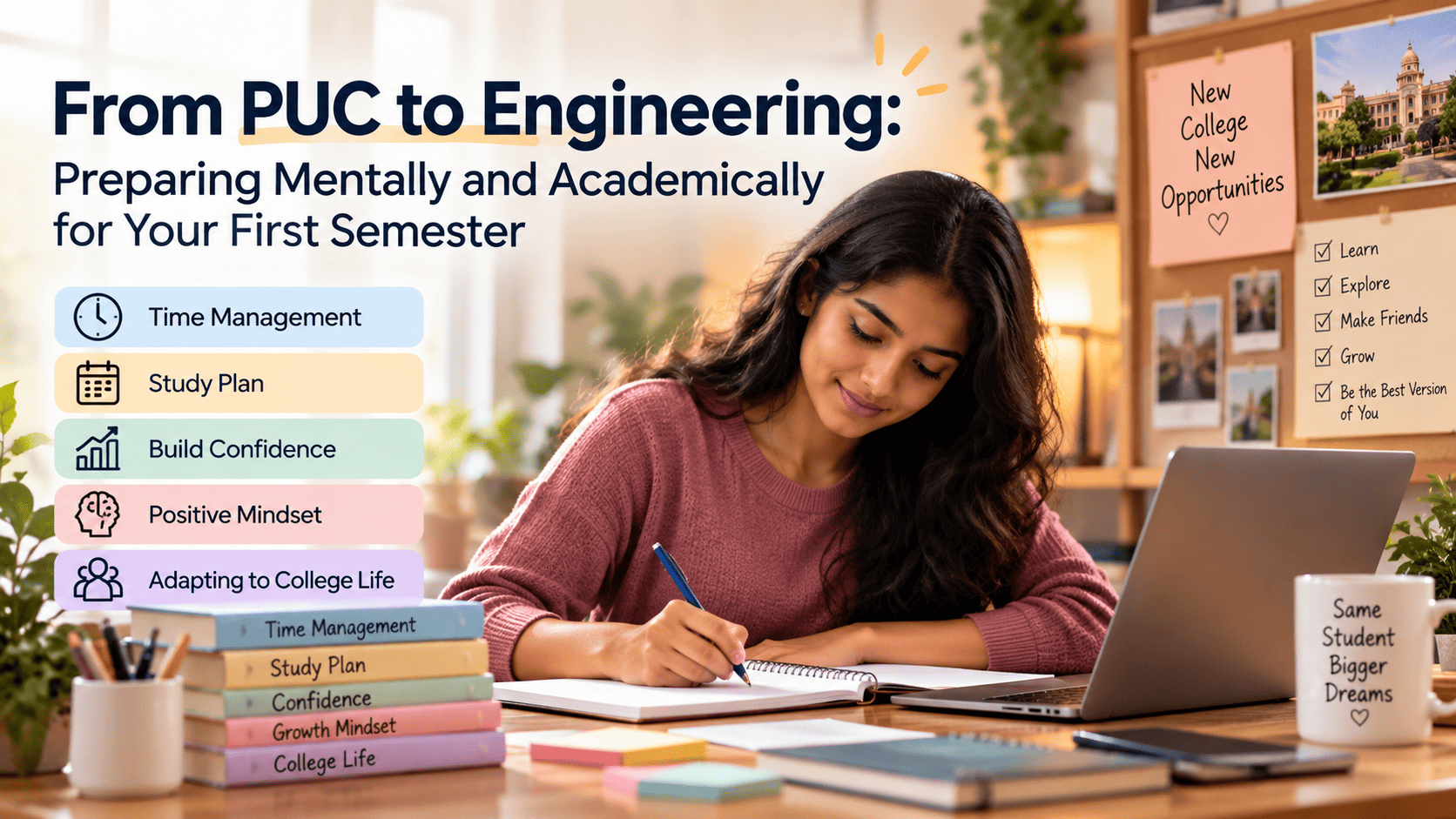
Moving from PUC to engineering can feel challenging due to the increased academic workload. Managing your time well, staying consistent with practicals, and seeking help when needed can make the transition smoother. You don’t have to learn the entire syllabus before classes begin. Instead, focus on developing effective study habits, staying organised, and maintaining a positive mindset. With consistent effort and proper preparation, you can adjust to engineering life with confidence.
Preparing well for your first semester of engineering is all about staying consistent with your studies rather than relying on last-minute cramming.
- How Is Engineering Different From PUC?
- PUC follows a more structured schedule, whereas engineering involves a broader range of academic and campus activities, including practical coursework. Classes often move at a faster pace, and students are expected to take greater responsibility for self-study.
- One of the most important tips for transitioning from school to college is to become more independent. Instead of relying on others for reminders, develop the habit of checking your timetable, tracking assignments and tests, and completing laboratory work on time. Learning to manage these responsibilities independently will help you adjust to college life.
- Engineering also places a strong emphasis on practical learning. Along with classroom lectures, you’ll attend laboratory sessions, work with new software, complete assignments, and participate in small projects that help you apply theoretical concepts.
- The semester system can move quickly, with internal assessments, quizzes, practical sessions, and final examinations scheduled within a relatively short period. Therefore, reviewing the current academic scheme before classes begin can help you understand the course structure, plan your studies, and stay prepared throughout the semester.
Academic Preparation Tips
Table of Contents
ToggleHere are some practical tips to help you prepare for your first year of engineering and begin your academic journey with confidence.
1. Revise Core PUC Concepts
Refresh your foundational knowledge of Mathematics, Physics, and Chemistry, focusing on topics such as algebra, calculus, vectors, units, and fundamental scientific principles.
If you studied Biology alongside the core sciences, spend extra time strengthening your mathematical skills. Analytical thinking and problem-solving are essential components of most engineering programmes.
2. Get Familiar with the Syllabus
Avoid relying solely on old notes or online resources. Understanding your course structure is an important step in preparing for your first semester of engineering. Review the current syllabus, course requirements, credits, and practical sessions before classes begin.
3. Build Basic Coding Skills
Students entering computer-related engineering streams will benefit from understanding basic programming concepts. You can start with variables, conditional statements, loops, and simple problem-solving exercises.
You don’t need prior coding experience to get started. Familiarising yourself with programming logic can make your initial classes easier to follow.
4. Understand Engineering Drawing
If engineering drawing is part of your curriculum, familiarise yourself with basic geometric shapes, projections, dimensions, and annotations.
Engineering drawing is a precise way of communicating the shape, dimensions, and structure of a component. Therefore, accuracy, attention to detail, and understanding of technical conventions are more important than artistic ability.
5. Develop Effective Note-Taking Habits
Make a habit of taking clear, organised notes during lectures. Focus on important formulas, definitions, worked examples, and concepts you find difficult to understand.
Review your notes within 24 hours of each class to reinforce what you have learned. Following this simple practice can help you address knowledge gaps early and avoid unnecessary stress during examinations.
6. Plan Your Weekly Schedule
Effective time management begins with a realistic weekly schedule that balances study sessions, laboratory work, assignments, revision, and sufficient sleep.
Avoid overloading your timetable with unrealistic study goals. Instead, set aside dedicated time for each subject, break larger tasks into manageable steps, and review your progress regularly. A consistent routine will help you stay organised and adapt more easily to the demands of engineering.
Mental and Emotional Preparation Tips
Accept That Adjustment Takes Time
One of the most important things to remember before starting engineering is that you don’t need to know everything during your first week. The transition may feel overwhelming at first, with new classmates, unfamiliar subjects, and a different schedule. Give yourself time to adjust and settle into your new environment.
Manage Homesickness and Hostel Life
Moving into a hostel is a significant milestone that brings greater independence and responsibility. During your first few weeks, establish a simple daily routine that balances study time, rest, and regular calls with family. Keep your living space organised, and approach your hostel warden or teachers whenever you need help with a problem.
Build a Support Network
Connect with your classmates, form study groups, and seek guidance from your seniors when needed. While seniors can share valuable experiences, consult your faculty members to clarify academic requirements and course-related doubts.
MVJCE follows a mentor-mentee approach in which each faculty mentor guides a group of 20 students, offering academic guidance and support throughout their college journey.
What to Expect in Your First Semester at MVJCE
First-semester subjects vary depending on the engineering branch and the applicable academic scheme. The curriculum typically includes Mathematics, science subjects, programming, engineering drawing, practical sessions, and other foundational courses.
At MVJCE, the first-year curriculum also includes separate Physics and Chemistry cycles, combining theoretical learning with hands-on laboratory experience, depending on the applicable scheme.
To make the most of your transition to college, attend all induction and orientation sessions organised by MVJCE, review the academic calendar, and stay informed about campus announcements.
Common First-Semester Mistakes to Avoid
One of the most useful tips for first-year engineering students is to recognise and avoid common academic mistakes, such as:
- Skipping lectures because the topics initially seem easy.
- Delaying revision until examinations are approaching.
- Recording laboratory observations without understanding the experiment.
- Leaving doubts unresolved for several weeks.
- Staying up late regularly and compromising on sleep.
- Failing to maintain a consistent daily routine.
Another important part of transitioning from PUC to engineering is learning how to handle disappointing academic results. If you receive a lower score than expected, analyse your mistakes, seek guidance from your professors, and adjust your study methods accordingly. Treat setbacks as opportunities to improve rather than reasons to lose confidence.
How MVJCE Supports First-Year Students
MVJCE offers several facilities and support systems to help first-year students adapt to engineering education and campus life.
1. 1:20 Mentorship Programme
Each faculty mentor guides a group of 20 students, providing personalised academic guidance and support with their overall college experience.
2. Comprehensive Induction Programme
A dedicated committee helps new students understand college life, academic expectations, examination procedures, and campus culture, making the transition to engineering smoother.
3. Academic Infrastructure
Students have access to departmental laboratories, campus-wide Wi-Fi, and a Central Library that operates from 8:00 AM to 8:00 PM, Monday through Saturday, except on the first and third Saturdays and national or gazetted holidays.
4. Secure On-Campus Hostels
MVJCE provides separate on-campus hostel facilities for men and women, with resident wardens available 24/7 to support students. Hostel amenities include Wi-Fi, recreation areas, and sports facilities.
5. Vibrant Campus Life
Technical and cultural clubs give students opportunities to build friendships, develop practical skills, explore their interests, and maintain a healthy balance between academics and extracurricular activities.
There are many things to understand before starting engineering, but the essentials are simple: stay consistent, seek help when needed, and give yourself time to adjust.
Preparing for your first semester is not about rushing through the syllabus before classes begin. It is about developing effective habits, building confidence, and establishing a routine that will support you throughout your engineering journey.
Frequently Asked Questions
1. Is First-Year Engineering Harder Than PUC?
Engineering can feel challenging initially because of the faster pace, broader coursework, and greater emphasis on independent learning. However, regular revision, effective time management, and consistent study habits can make the workload easier to manage.
2. How Do I Balance Studies and College Life in the First Semester?
Set clear priorities and attend lectures regularly. Complete assignments and other important tasks within their deadlines. At the same time, maintain a balanced routine that includes sufficient rest, hobbies, and opportunities to socialise.
3. What Subjects Are Typically Covered in the First Semester of B.E.?
The curriculum generally includes Mathematics, Physics or Chemistry, programming, engineering drawing, laboratory subjects, and other foundational courses. The exact subjects depend on the engineering branch and the applicable academic scheme.
4. How Can I Cope with Homesickness or Hostel Life?
Establish a routine that includes study time, adequate rest, and regular calls with family. Build relationships with your roommates, participate in campus activities, and seek support from your hostel warden, faculty mentor, or teachers whenever necessary.
5. Is Coding Knowledge Required Before Starting Engineering?
Prior coding knowledge is not mandatory for beginners in most engineering programmes. However, learning basic programming concepts beforehand can be helpful, particularly for students entering computer-related branches. A willingness to practise and learn is more important than having previous coding experience.
