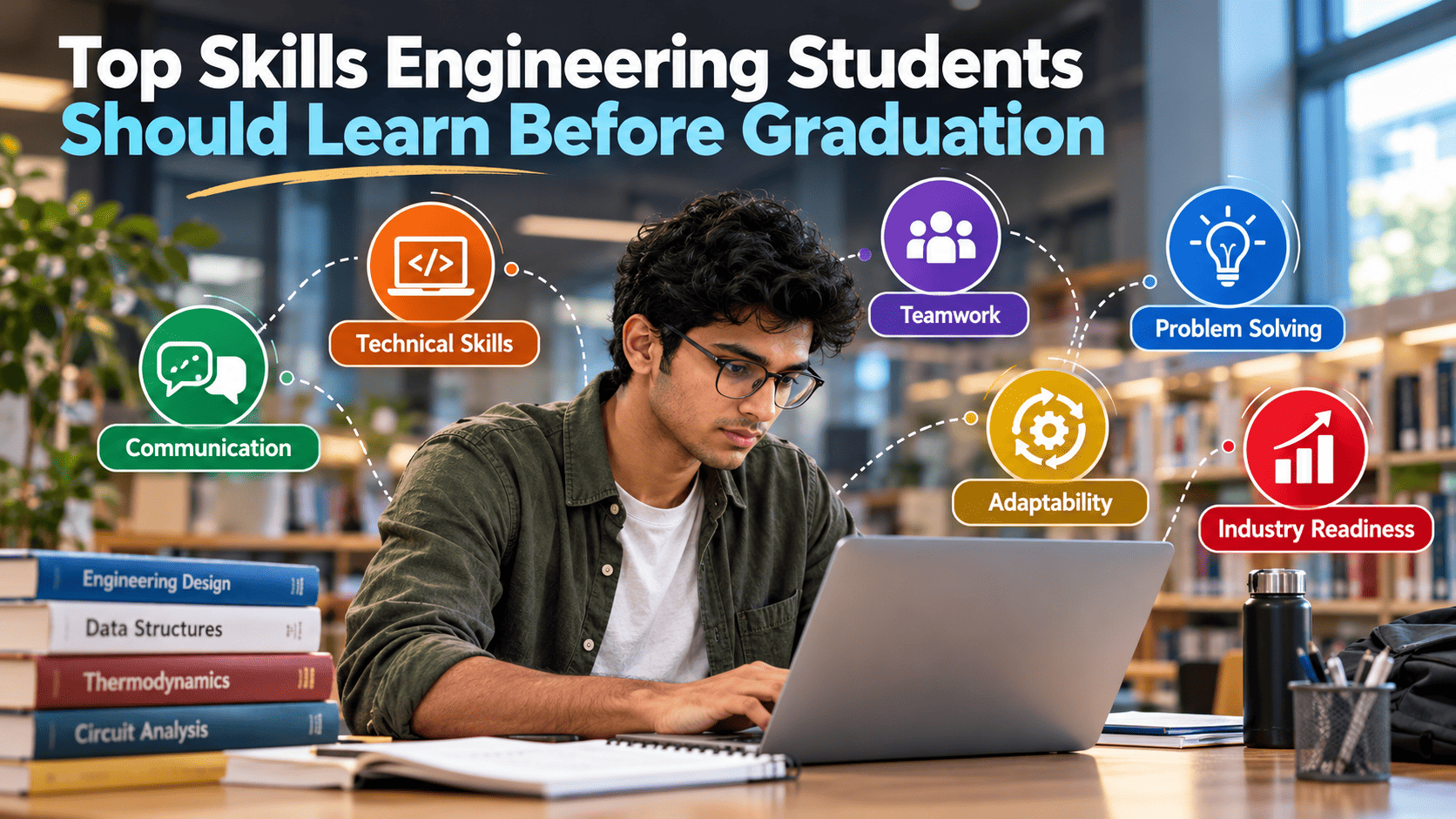
The most valuable skills required for engineering students before graduation are programming, data structures, domain-specific technical proficiency, hands-on project experience, familiarity with industry tools, communication, teamwork, problem-solving, time management, adaptability, and continuous learning.
These ten abilities determine how prepared a graduate is for the workplace, and we examine each below, with guidance on when to build it.
Why a Degree Alone No Longer Gets You Hired
Table of Contents
ToggleAn engineering degree confirms that a student has completed a prescribed course of study. However, employability depends on much more than a qualification. Today, recruiters place greater emphasis on demonstrated skills and the ability to deliver results than on credentials alone. Between academic knowledge and practical competence lies a significant gap, and it is within this gap that many graduates struggle.
Recent employability data highlights this challenge. The India Skills Report 2026, the thirteenth edition of the annual study released by ETS in collaboration with CII, AICTE, AIU, and Taggd, reported an employability rate of 70.15% among BE and BTech graduates, a slight decline from 71.5% in the previous year. While the report describes this as a sign of stability in technical disciplines despite increasing specialization requirements, it also reveals that employability varies across domains. Computer Science graduates recorded an employability rate of 80%, while IT graduates stood at 78%, reflecting strong industry demand for skills in artificial intelligence, data analytics, and automation.
Although these figures are encouraging, they also indicate that nearly three out of every ten engineering graduates remain outside relevant employment opportunities. The difference between those who succeed and those who do not is rarely the degree itself. In today’s job market, employers increasingly value proven capability, practical experience, project portfolios, problem-solving skills, and industry readiness over academic scores alone.
Technical Skills to Build Before You Graduate
Every hiring decision rests on the technical skills of engineering students. Employers evaluate these capabilities through coding rounds, technical interviews, and practical assessments, leaving little room for ambiguity. In a competitive job market, skills cannot be left to chance. They must be built through sustained practice, hands-on projects, internships, and application-oriented learning.
Priorities before graduation include:
- Programming Proficiency in at least one language, such as C++, Java, or Python, enabling the development of efficient and scalable solutions.
- Data Structures and Algorithms, which form the foundation of problem-solving and are assessed in most technical recruitment processes.
- Domain Expertise with a strong understanding of core concepts in your discipline, whether circuit design, structural analysis, thermodynamics, manufacturing, or communication systems.
- Industry Tools and Software used in professional practice, such as AutoCAD, MATLAB, SolidWorks, ANSYS, Cadence, or other domain-specific platforms.
- Project Experience gained through mini-projects, capstone projects, internships, hackathons, research activities, or product development initiatives.
- Emerging Technology Skills relevant to your field, including Artificial Intelligence, Machine Learning, Data Analytics, IoT, Cloud Computing, Cybersecurity, Digital Twin technologies, or Automation.
- Professional and Communication Skills, including teamwork, presentation abilities, technical documentation, problem-solving, and collaboration in multidisciplinary environments.
- Industry Exposure and Practical Application through internships, industry certifications, workshops, competitions, open-source contributions, or real-world engineering challenges.
Technical skills are built through repeated practice, not theory in isolation. As students design, test, troubleshoot, and deliver real projects, they convert academic knowledge into practical competence. A portfolio of genuine work provides evidence of capability that no transcript alone can capture, which is why recruiters often examine projects, internships, and hands-on experience before anything else.
Professional Skills That Decide Who Gets Promoted
Technical skills help graduates secure their first opportunity, but career progression depends on professional conduct and interpersonal effectiveness. Communication, teamwork, leadership, adaptability, and problem-solving skills shape how engineers perform in the workplace. While technical competence earns the interview, soft skills often determine how far a graduate advances.
The following qualities reward deliberate effort and sustained practice throughout an engineering career:
- Communication Skills – The ability to convey complex technical ideas clearly to colleagues, clients, stakeholders, and managers through effective written, verbal, and presentation skills.
- Teamwork and Collaboration – The capacity to work productively in multidisciplinary and cross-functional teams, which are increasingly the norm in modern engineering environments.
- Time Management – The discipline to prioritize tasks, meet deadlines, and deliver high-quality outcomes within project constraints.
- Adaptability – The willingness and ability to learn new technologies, tools, and methodologies as industries and job roles continue to evolve.
- Continuous Learning – A commitment to lifelong learning, recognizing that today’s tools, frameworks, and technologies may be replaced by new developments in the years ahead.
- Problem-Solving and Critical Thinking – The ability to analyze challenges, evaluate alternatives, and develop practical, innovative solutions in complex situations.
- Leadership and Initiative – The confidence to take ownership of tasks, guide teams when required, and contribute proactively to organizational goals.
- Professionalism and Ethics – Demonstrating integrity, accountability, respect, and ethical decision-making in professional practice.
Students fixed on technical preparation alone tend to undervalue these soft skills for engineers. That is a costly oversight, because they are among the clearest skills employers look for in engineering graduates, and they resist teaching once a candidate joins a company. Precise communication and reliable collaboration hand an engineer an advantage that grows across a whole career.
When to Build Each Skill: A Year-by-Year Plan
Built in sequence over four years rather than crammed into the final months, skills accumulate far more effectively. A practical progression appears below.
| Year | Focus | Key Actions |
| First year | Foundations | Learn one programming language, strengthen mathematics, join a technical club |
| Second year | Core building | Master data structures, begin domain subjects, take on small projects |
| Third year | Application | Complete an internship, build a substantial project, develop aptitude and communication |
| Fourth year | Placement readiness | Refine your resume, practise interviews, deliver the final-year project |
Handled this way, the skills required for engineering students develop steadily, without the last-minute pressure that defeats so many candidates. Consistent early progress delivers a graduate who is ready well before the placement season begins.
This is also how structured training works at MVJCE. The programme runs across all four years rather than concentrating on the final semesters: communication and soft skills in the first year, aptitude and foundational technical training in the second, domain-specific and advanced technical training in the third, and company-specific preparation in the fourth, tied to the recruiters visiting that season. Faculty mentoring runs alongside it throughout.
Where to Build These Skills on Campus
Beyond the prescribed syllabus, a well-equipped campus holds far more, and the students who draw on it graduate clearly ahead. That opportunity takes several forms:
- Technical clubs and coding communities, where practical experience goes beyond what any classroom offers.
- Hackathons and technical festivals, which test problem-solving against real constraints.
- Internships, giving direct exposure to professional practice and workplace standards.
- Workshops and guest lectures, linking students to what the industry currently expects.
- Literary, debating, and organising committees, which grow the communication and leadership qualities recruiters prize.
Many of these are woven into everyday campus life at MVJCE, from the Software Development Club and the Tinkering Lab to VertechX, the college’s national technical fest, and Toastmasters for communication practice. Together they let students build technical and professional competence across all four years.
Conclusion: Graduate Ready, Not Just Qualified
Qualification is what a degree confirms, but employability has to be earned, through the deliberate development of the skills required for engineering students set out above. The graduates who attract the strongest offers are those who combined technical depth with professional maturity and started early on both.
Explore the programmes and skill-focused campus environment at MVJCE and prepare to graduate genuinely ready for the profession.
FAQs
1. What skills do companies look for in engineering graduates?
Recruiters seek a combination of technical and professional skills. Programming proficiency, problem-solving ability, domain knowledge, and project experience are highly valued, along with communication, teamwork, and adaptability. Graduates who demonstrate strength in both areas are often better positioned for career success.
2. Are certifications necessary for engineering students?
No, certifications are not mandatory. However, relevant certifications can strengthen a resume by validating specific skills and demonstrating initiative. Their value increases when supported by practical projects, internships, or hands-on experience.
3. Which skill matters more: technical skills or communication skills?
Neither is inherently more important. Technical skills help secure interviews and employment opportunities, while communication and other professional skills influence workplace effectiveness, career growth, and leadership potential. Both are essential for long-term success.
4. When should an engineering student start building these skills?
Ideally, from the first year of engineering. Building technical and professional skills gradually over four years allows students to gain deeper competence and confidence, making them better prepared for internships, placements, and future career opportunities.
